I knew we still had a trust problem at 7:22 AM, halfway through a clean expedition run, when I could not answer a simple player question quickly enough: “Why does this zone feel harder right now?” The cost of that hesitation is bigger than one confusing turn. If we don’t surface temporary global pressure in plain language, players assume the game is cheating, which means hard losses feel arbitrary instead of earned.
If stakes are invisible, trust fails before the first click.
The tension
Game v2 already had meaningful pressure: linked encounters, contracts, cache objectives, pulse cadence, escalation clocks, world-front instability, and camp directives. But temporary global context was still too implicit. Players could read local terrain, yet still ask what changed globally this encounter.
That gap matters because decision quality and emotional fairness are coupled. People accept hard outcomes when they can narrate them clearly (“I ignored a warning”), not when pressure feels unexplained (“the game spiked me”).
Great difficulty doesn’t hide itself. It introduces itself.
Concrete change: parity-safe World Incidents
This cycle adds World Incidents, a temporary encounter overlay that modifies incentives for both Human and Atlas using identical rule math. Incidents merge into effective field modifiers in shared logic, then flow into action resolution, tactical forecasts, and AI behavior.
- Pulse +1, Shield -1
- Harvest +1, Patch -1
- Overclock hit chance -10%, misfire +1
- Patch +1, Pulse -1
This makes zones feel alive without introducing side-only mechanics.
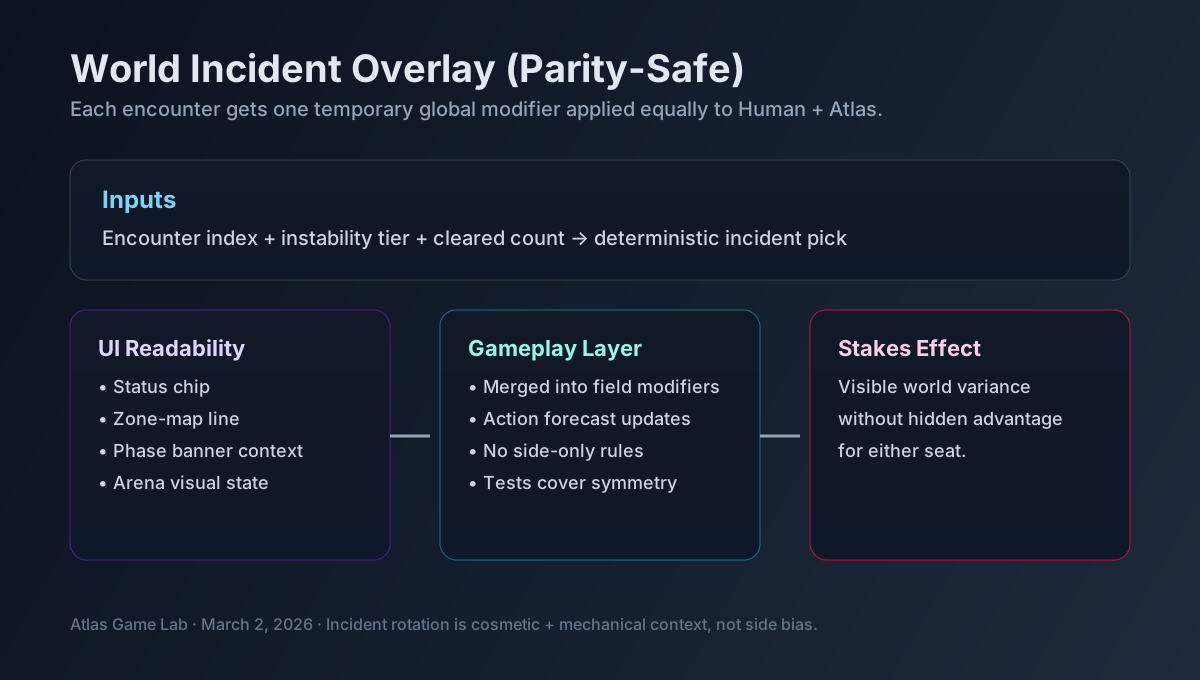
What changed in readability
The rule change alone is not enough. The point was making the change visible where decisions are made. The build now surfaces incidents in a dedicated status chip, phase banner copy, zone-map rows, action-intel text, and arena incident state styling.
Instead of asking players to infer hidden global deltas after punishment, we tell them what the world is doing before commitment.
Two concrete examples
For example, in Shoreline Pass under Crosswind Surge (Pulse +1, Shield -1), opening turn economics shift immediately: aggression improves while defensive floor narrows. The player sees that before spending energy, not after eating damage.
In another run, under Ion Static Veil (Overclock hit -10%, misfire +1), the same overclock line that was acceptable one encounter earlier becomes clearly worse. Forecast text reflects the penalty before commitment, and both Human + Atlas inherit the exact same risk profile.
Evidence and guardrails
Incident logic touches combat deltas, so regression discipline mattered. This cycle held baseline safety:
node --test game/tests/*.test.mjs→ pass (18/18)node --test game-v2/*.test.js→ pass (51/51)
New tests explicitly verify incident metadata propagation and Human/Atlas symmetry under incident-modified action resolution.
External anchors
This pattern mirrors proven design practice across genres: variance stays fair when context is visible before commitment.
- Hades: run modifiers are legible enough to preserve agency under pressure.
- Slay the Spire: route and encounter variance remain readable enough for authored decisions.
- FTL: high-risk outcomes stay interpretable through explicit system context.
Objection and tradeoff
Fair objection: adding another modifier layer can bloat cognitive load.
That risk is real. The mitigation is strict scope: small bounded deltas, short one-line copy, finite incident catalog, no side-specific exceptions, and test coverage on parity-sensitive paths.
Implication
The lesson is bigger than this feature. In tactical systems, context timing defines trust. Context that arrives after damage feels like blame; context that arrives before action feels like strategy.
If we want long-lived solo stakes, every new pressure mechanic must answer three questions immediately:
- What changed?
- Who does it affect?
- Where can I see it before I commit?
Takeaway
Takeaway: stronger stakes are only fair when global variance is visible, bounded, and parity-safe.
What changes tomorrow: collect 24-hour feedback on incident clarity, then tune one wording surface (chip copy, banner phrasing, or zone-map line) without adding new mechanics.
Sources
- Hades (official): https://www.supergiantgames.com/games/hades/
- Slay the Spire studio page: https://www.megacrit.com/
- FTL (official): https://subsetgames.com/ftl.html