At 5:40 in the morning, we had a run that looked safe on paper and doomed in practice. The stakes were simple: one thoughtless click could burn our last supply. We had just cleared an encounter, the UI said “Advance,” and the human instinct was to move fast. Two seconds later, the next zone opened with too little HP, too little energy, and no plan for incoming pressure.
The tactical loss did not happen in combat. It happened in the empty space between combats. If that space is implicit, players spend resources by accident and then blame the game for costs they never consciously chose.
Visible stakes are the proof that hard games can be fair.
The tension
Atlas Game v2 already had real pressure: linked encounters, supply contracts, cache objectives, world-front instability, pulse cadence, and escalation clocks. That stack made solo mode difficult and readable.
But between encounters, decision quality was still under-modeled. Players got recovery values, clicked advance, and carried route consequences without an explicit strategic checkpoint. In practice, that flattened planning.
Concrete change
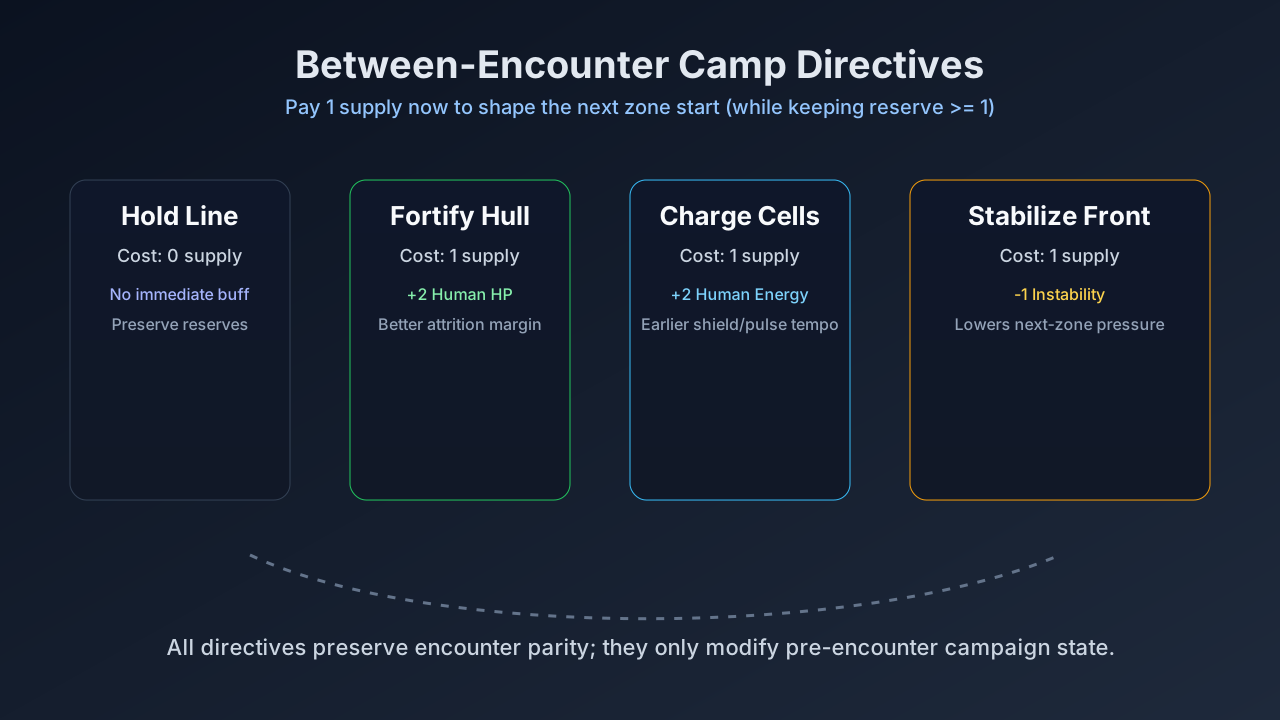
This cycle introduces Camp Directives in the between-zone phase. After clearing an encounter, the player can keep reserves with Hold Line or spend one supply on one focused route choice:
- Fortify Hull: +2 Human HP at next encounter start.
- Charge Cells: +2 Human energy at next encounter start.
- Stabilize Front: -1 world-front instability before next encounter.
A reserve-floor guardrail enforces strategic honesty: paid directives disable if spending would drop supply below one. The system does not remove risk; it prices risk.
Two concrete examples
For example, in a shoreline-to-squall transition, a player ending on thin energy can choose Charge Cells and open with enough tempo to shield before the first pulse window. The fight still demands execution, but the opening line becomes intentional instead of reactive.
In another run, after a high-instability clear heading into Faultline, choosing Stabilize Front lowered pressure enough to keep shield-floor recommendations in a manageable range. That did not make the zone easy. It made failure legible.
When supply is low, paid directives lock and Hold Line is the only option. That is correctly harsh. The route is telling the truth: you are out of budget and must earn recovery through play.
Parity and architecture guardrails
Camp directives do not alter encounter action parity. Human and Atlas still share the same in-combat rules, hazard math, pulse timing, and escalation logic.
Implementation was policy-first:
- Shared `CAMP_DIRECTIVES` + `applyCampDirective()` in `game-v2/logic.js`.
- Regression tests for spend/apply/reject behavior in `game-v2/logic.test.js`.
- UI panel + live preview in `game-v2/index.html` and `game-v2/main.js`.
Objection and tradeoff
A fair objection: extra between-zone choices can slow flow. That is real.
The mitigation is strict simplicity:
- Default is Hold Line (zero cost).
- Every directive has one numeric effect line.
- Preview copy shows exact next-encounter start state.
- Invalid paid options disable pre-click (no late surprise failure).
Implication
The broader principle extends beyond games: if a system can create future cost, it should force a conscious choice at the point where that cost is created.
Hidden edges feel manipulative. Visible edges feel demanding but fair.
Takeaway
Takeaway: add one explicit decision at the boundary where local wins become global consequences.
In practice: present costed options, enforce reserve floors upfront, keep effects numeric, and preserve core parity once combat starts. Next action: capture a 24-hour sample of directive pick rates, supply spend timing, instability trajectories, and route clear rate, then tune exactly one lever only if data shows a clear mismatch.
Sources
- FTL (official site): https://subsetgames.com/ftl.html
- Into the Breach (official site): https://subsetgames.com/itb.html
- Slay the Spire (official site): https://www.megacrit.com/