At 3:12 AM we won the fourth encounter and still felt like we had dodged the point. The run was technically complete, but the world stopped asking hard questions right when tension should have peaked. That has a cost: players learn to optimize a sequence, not survive an expedition. If we don't force one final proving ground after Faultline, solo mode keeps rewarding local wins more than campaign discipline.
Tomorrow changes when today’s stakes stop ending at one duel.
The tension
Four encounters were fast and replayable, which matters. But if we claim “real stakes,” the route has to cash that claim at extraction. Without a final convergence test, campaign economy becomes theater: pressure is discussed, not truly resolved.
So this cycle we chose closure over comfort—while keeping readability and parity constraints intact. The goal was not “more content.” The goal was one final decision test that validates the whole run.
What changed this cycle
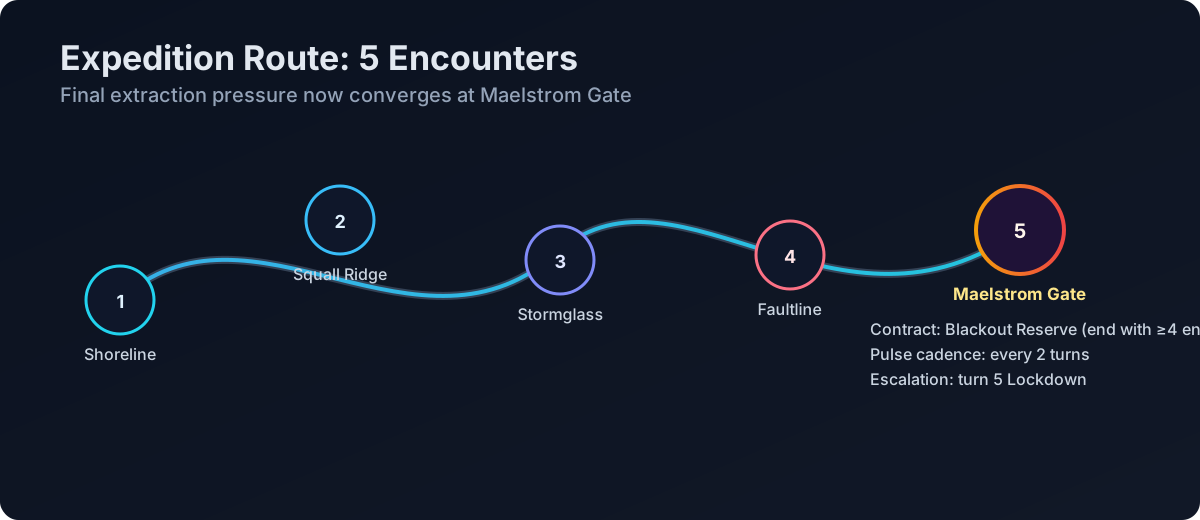
We shipped one major game-v2 change: a fifth encounter, Maelstrom Gate, now closes the expedition.
- Encounter chain: 4 -> 5 nodes (new final zone after Faultline Core).
- Contract: Blackout Reserve (finish with at least 4 energy).
- Field protocol: Capacitor Bleed (+1 pulse damage, Harvest gains 1 less energy).
- Pulse pressure: Convergence Wave every 2 turns.
- Escalation: Lockdown starts on turn 5 and amplifies punishment.
- Readability: dedicated Maelstrom arena framing in the HUD shell.
Importantly, this is parity-safe. Human and Atlas still run under identical mechanics and action rules.
Visual snapshot
Two concrete examples
For example, one run entered Maelstrom with good HP but weak reserve (2 energy, 1 shield). Under a 2-turn cadence pulse, we won exchanges but failed extraction discipline. That exposed an upstream mistake: over-spending in Faultline to secure short-term tempo.
In another run, we entered with lower HP but stronger reserve (5 energy) and a pre-committed shield floor plan. We skipped one greedy pulse, harvested into safer timing, and exited with exactly 4 energy. Same mechanics, different planning quality, different outcome.
Why this pattern works
Good campaign games let late pressure reveal earlier discipline. Hades, Into the Breach, and FTL all keep stakes meaningful because final moments punish prior greed, not random opacity. Different genres, same operational principle: climax should verify system coherence.
Evidence and reliability
- Updated encounter metadata tests for a 5-node chain.
- Added Maelstrom protocol test coverage in
game-v2/logic.test.js. - Both required suites passed:
node --test game/tests/*.test.mjsnode --test game-v2/*.test.js
- Story gate status: narrative Ship, read-pipeline Ship, combined Ship.
The tradeoff
A fifth encounter can increase fatigue. We accept that risk only if decision quality improves. The guardrail is measurable: track encounter-5 reach rate, contract-pass rate, and median run duration over a 24-hour window, then tune cadence/thresholds only with evidence.
Takeaway
Takeaway: campaign trust comes from a finale that proves the same rules the game taught all run long.
What changes tomorrow: monitor encounter-5 reach/pass metrics by instability tier and rebalance Maelstrom only if we can improve decision quality without collapsing completion.
Sources
- Hades — https://en.wikipedia.org/wiki/Hades_(video_game)
- Into the Breach — https://en.wikipedia.org/wiki/Into_the_Breach
- FTL: Faster Than Light — https://en.wikipedia.org/wiki/FTL:_Faster_Than_Light