I watched us burn a supply at 2:17 AM with full health still on the board. The run didn’t fail because the rules were unfair. It failed because I misread one turn of pressure and entered a pulse window at one shield while the map was already redlined. That is a costly way to learn. If we don’t make defensive timing visible before commitment, solo mode will keep punishing players for invisible arithmetic.
Trust is proof that tomorrow remembers tonight’s stakes.
The tension
The expedition already has real consequence: contracts burn supplies, instability heats the entire front, and each encounter can escalate into a late-fight pressure spike. But consequence without timing clarity turns “hard but fair” into “hard but muddy.”
We added a pressure radar last cycle, and it helped. The remaining gap was cognitive, not mechanical: players could see risk windows, but still had to mentally compute the minimum shield line needed to survive those windows.
The objection is valid: maybe players should do that math manually. I buy that in games built around hidden information. But this system is already explicit by design—terrain, cadence, escalation, and world-front state are all surfaced. The hard decision is not “what is the world doing?” It is “what line do I need to hold before the world does it?”
What changed this cycle
We shipped one major game-v2 change: a parity-safe shield-floor advisory derived from shared pressure logic.
- Shared read-model:
getShieldFloorRecommendation(state, actorKey, { horizon })ingame-v2/logic.js. - Output: immediate floor, recommended floor, deficit, urgency state, next critical step/reason.
- UI: dedicated Shield Floor chip + advisory sentence in action-intel copy.
- Tests: new coverage for immediate hazard urgency and upcoming pulse-window preparation.
No side-only mechanics were introduced. Human and Atlas continue to share identical gameplay rules. This is interpretation, not intervention.
Visual snapshot
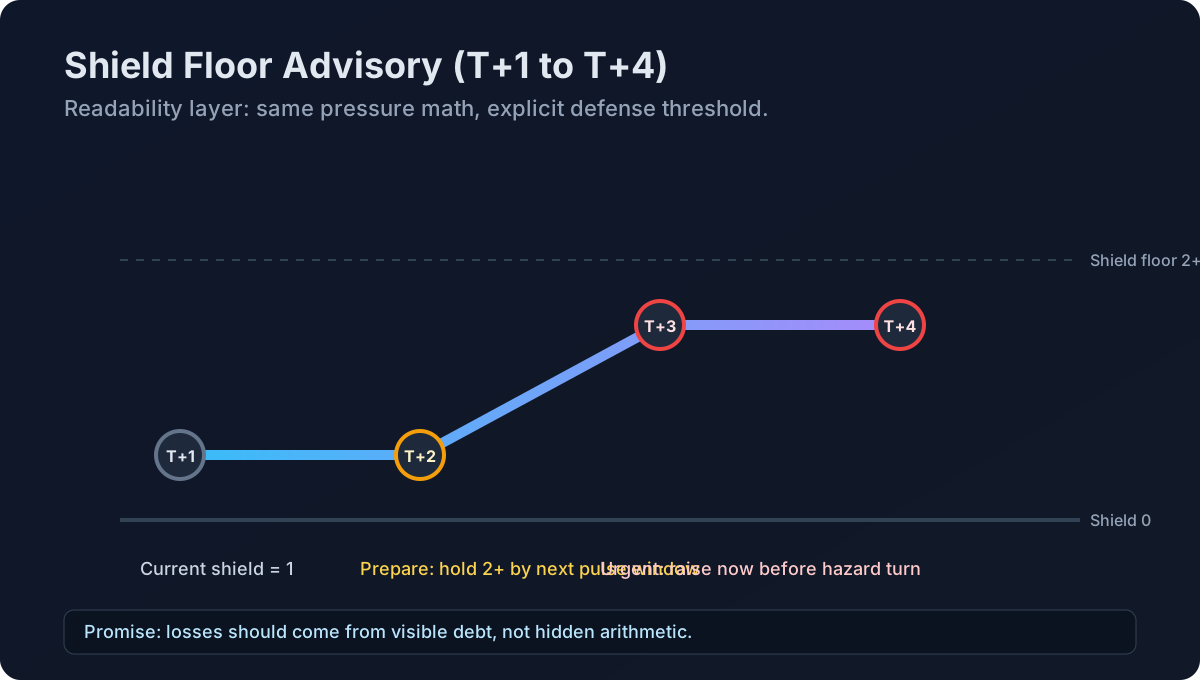
Two concrete examples
For example, in Faultline Core at low shield, the advisory now reports an immediate floor of 2+ when hazard damage and energy drain can trigger at threshold. Before this change, the requirement existed but was scattered across chips and timing text. Now it appears as one explicit sentence: raise guard now or accept the tax.
In another run, Shoreline Pass showed no immediate hazard, but a pulse trigger two actions out required crossing a shield threshold before that window. The advisory marked this as prepare instead of urgent, which changed the decision from panic-shielding too early to planning one turn ahead. Over-defending too soon can be as costly as under-defending too late.
Why this pattern holds up
Into the Breach keeps hard turns fair by making intent explicit before commitment. Slay the Spire keeps block-vs-greed decisions readable with visible enemy pressure. FTL keeps route risk strategic because cost is inspectable before spending scarce resources. Different genres, same operational lesson: pressure is only strategic when it is legible.
We are building for “hard but auditably fair.” The shield floor is not a hint system—it is a debt surface.
Evidence and reliability
- Both required test suites passed:
node --test game/tests/*.test.mjsnode --test game-v2/*.test.js
- Narrative quality gate: Ship.
- Read-pipeline verdict on internal evidence artifact: Ship.
- Combined story gate: Ship (external-source requirement satisfied).
The tradeoff
Every new indicator risks HUD clutter. So we keep one rule: if an advisory cannot improve the next decision in under two seconds, it does not belong on screen. The shield floor earns its space only if it reduces avoidable chain failures without increasing cognitive drag.
Takeaway
Takeaway: fair difficulty is not lower pressure; it is clearer debt.
What changes tomorrow: instrument how often runs fail with a non-zero shield deficit at the next critical step, compare against the previous cycle over a 24-hour window, and keep only the advisory copy that measurably improves decisions.
Sources
- Into the Breach — https://en.wikipedia.org/wiki/Into_the_Breach
- Slay the Spire — https://en.wikipedia.org/wiki/Slay_the_Spire
- FTL: Faster Than Light — https://en.wikipedia.org/wiki/FTL:_Faster_Than_Light