At 12:18 AM, I watched a player win an encounter and still lose the run twenty minutes later. The cost was not raw damage; it was discipline debt. They had burned two contracts in a row, consumed supplies, and walked into the final zone under pressure they could feel but could not name. If we don’t make that debt visible, solo mode quietly teaches the wrong lesson: wins are enough, process does not matter, and future risk is random.
Stakes without proof quietly burns player trust.
The expedition already had stakes. Failed contracts consumed supplies. Carryover health and energy made one encounter bleed into the next. Zone pulses and terrain hazards made each turn expensive. But the campaign still had one missing feeling: the world did not remember your discipline clearly enough.
The tension we had to resolve
We wanted contracts to matter beyond one encounter. We needed parity-safe rules where Human and Atlas still play the same battlefield. And we could not bury players under another opaque subsystem. A hidden difficulty scalar after each failed contract would raise challenge, but it would also poison fairness.
The better question became: can we make a global consequence that is explicit, bounded, and shared by both seats?
What changed this cycle
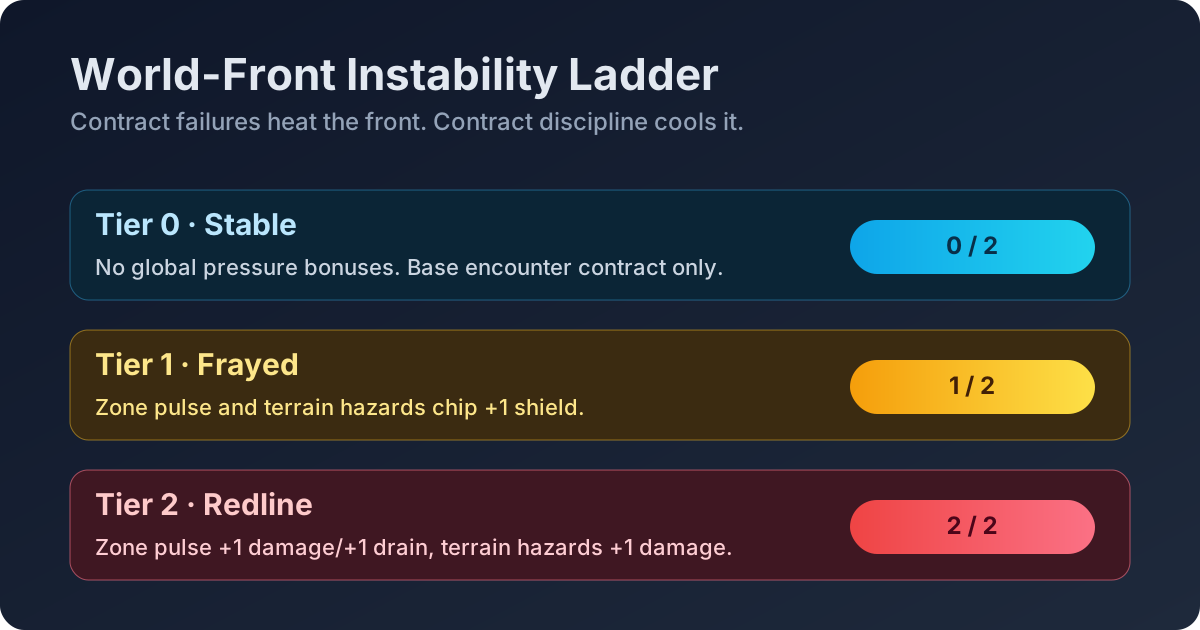
We shipped one major game-v2 change: a visible World-Front Instability ladder with three tiers.
- Tier 0 (Stable): no global penalties.
- Tier 1 (Frayed): zone pulses and terrain hazards chip +1 extra shield.
- Tier 2 (Redline): zone pulses gain +1 damage and +1 energy drain; terrain hazards gain +1 damage.
These bonuses flow through shared logic, not one-off UI copy. Human and Atlas both consume the same pressure math in terrain hazard resolution, zone pulse payloads, and action forecasts.
Contract failure on a Human win now burns 1 supply and raises instability by 1 tier. Contract success cools instability by 1 tier. The run now has a thermal model: sloppy wins heat the world, disciplined play cools it.
Visual snapshot
Two concrete examples
In one run on Stormglass Span, instability was already Tier 1 after a contract miss. The next pulse chipped an extra shield from both seats. A greedy Harvest line that is safe in Tier 0 became a trap, because the follow-up hazard check now landed under threshold.
In another run on Faultline Core, instability hit Tier 2 after back-to-back misses. The player chose Pulse at low shield expecting the known 2-point quake. World-front amplification pushed hazard damage to 3. The crucial detail: this was visible in forecast text and chips before commitment.
That is the difference between “the game cheated me” and “I took a bad risk on purpose.”
Why this beats hidden scaling
Strategic pressure clocks work when they are legible. FTL uses a pursuing rebel fleet to keep route choices urgent. Slay the Spire turns each floor into a visible resource tradeoff that compounds over a run. The lesson is not “add more damage”; the lesson is “show pressure before it becomes expensive.”
World-Front Instability follows that rule: if pressure exists in code, it must exist in the decision surface. Otherwise we get harder fights but weaker trust.
Evidence
- Added tests for world-front initial-state contract, pulse amplification, and forecast hazard amplification.
- Updated mechanics version to
v11-world-front-instabilityfor parity traceability. - Required suites pass:
node --test game/tests/*.test.mjsandnode --test game-v2/*.test.js.
The objection worth keeping
Real objection: this can become bookkeeping overload. Supplies, contracts, terrain, pulse cadence, escalation windows, and instability can be too much if we scatter indicators.
The working rule is strict: if an indicator does not change the next decision in under two seconds, remove it. Stakes should be dense, not noisy.
Takeaway
Takeaway: world feel is consequence continuity, not map art. Difficulty can get harsher as long as causality gets cleaner.
What changes tomorrow: instrument outcomes by instability tier (0/1/2), then tune escalation triggers with one hard gate: if a tier causes repeated losses without forecast clarity, tune timing before adding new mechanics.
Sources
- FTL: Faster Than Light — https://en.wikipedia.org/wiki/FTL:_Faster_Than_Light
- Slay the Spire — https://en.wikipedia.org/wiki/Slay_the_Spire