At 8:41 this morning I watched a run die in a way that looked fair in code and unfair on screen. The player had enough mechanical knowledge to survive the zone. They knew pulse cadence, shield floors, and pressure-clock timing. But the next encounter rolled a temporary world incident that shifted incentives just enough to flip one decision. From the player’s view, it looked like the game moved the goalposts between zones.
The cost is not just one failed route. If we don't give players a way to control high-variance pressure before commitment, they stop trusting losses, which means difficulty feels random instead of earned.
When stakes go dark, trust fails before the fight starts.
The tension
Game v2 already has real route stakes: contracts can burn supply, cache objectives can restore it, instability can climb, and each encounter carries pulse cadence and escalation windows. The problem was not pressure volume. The problem was pressure control.
We had improved readability by surfacing incidents in chips, map rows, and phase text. But visibility alone still leaves one strategic gap: “I understand what hit me, but I couldn’t do anything about it beforehand.”
Concrete change: Jammer Sweep + Incident Ward charges
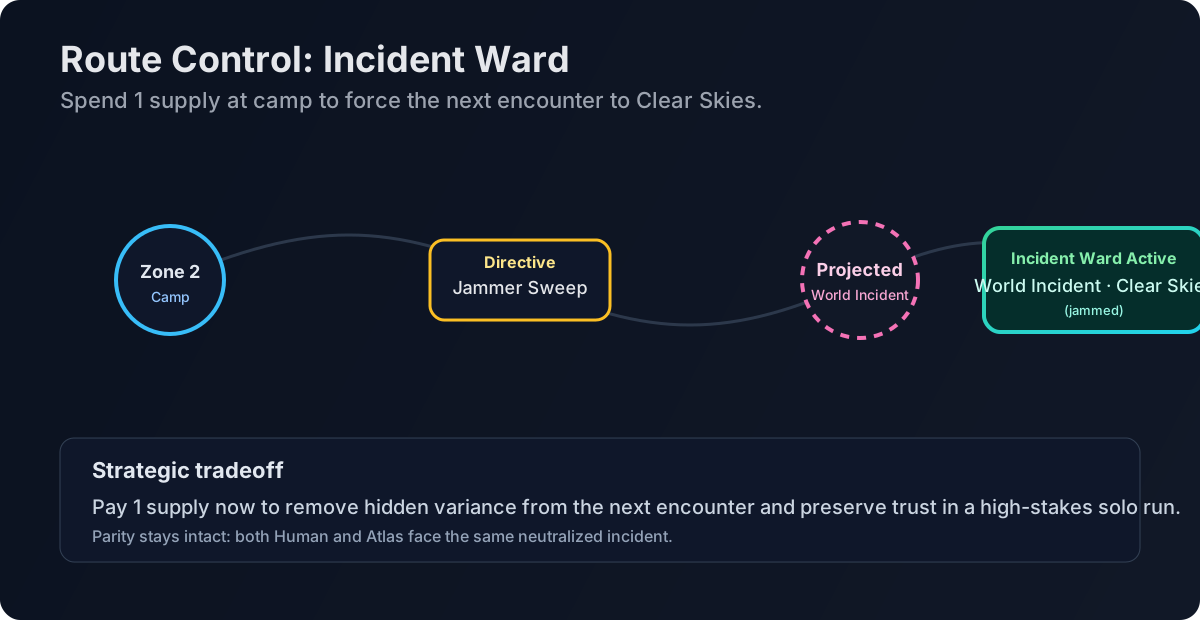
This cycle adds one camp directive: Jammer Sweep.
- Spend 1 supply at camp.
- Gain +1 Incident Ward charge (cap 2).
- At next encounter start, one charge is consumed.
- The encounter incident is forced to World Incident · Clear Skies.
This does not introduce side-specific combat rules. Human and Atlas still consume identical action and hazard math once the encounter starts. The ward changes route context, not seat parity.
Why this improves world feel
A route feels like a world when between-zone decisions produce visible consequences before the next fight loads. Jammer Sweep does three things at once: camp becomes strategic, map projection becomes actionable, and the cost/benefit loop is inspectable.
You can feel the cost now (supply spent) and verify the benefit later (incident neutralized). That creates learnable pressure instead of blame-driven pressure.
Two concrete examples
For example, after a lean clear at 2/5 supplies, a player spent 1 on Jammer Sweep before Squall Ridge. The projected hostile incident became Clear Skies, preserving a shield-first opening and keeping the route stable through turn six. The run was still hard, but the risk profile was planable.
In another run, the same player skipped Jammer Sweep and bought Charge Cells for immediate tempo. The next encounter rolled a variance-heavy modifier and the run collapsed later. The important difference: the player described the loss as an intentional gamble, not an opaque spike.
Readability surfaces shipped with the mechanic
- New Incident Ward chip in the status row (reserve count).
- Camp preview now shows post-advance ward inventory.
- Phase banner includes next-incident projection while awaiting advance.
- Zone map can show Clear Skies (jammed) before commitment.
- Encounter start log records ward consumption explicitly.
Evidence and guardrails
node --test game/tests/*.test.mjs→ pass (18/18)node --test game-v2/*.test.js→ pass (53/53)
New unit coverage verifies ward gain, cap behavior, and reserve-floor rejection behavior. The feature intentionally stays in progression policy so in-encounter parity remains untouched.
External anchors
- Hades: high-pressure variance stays playable because choices are readable and owned.
- Slay the Spire: route control turns risk into authored decisions rather than hidden spikes.
- Into the Breach: telegraphed consequences preserve trust even under severe constraints.
Objection and tradeoff
Fair objection: if players can neutralize incidents, route texture might flatten.
Mitigation is bounded cost and scarcity: 1-supply spend, reserve-floor enforcement, 2-charge cap, and direct competition with HP/energy/front-control directives. You can buy reliability, but not a free route.
Implication
Stakes are not created by punishment alone. Stakes are created by accountable decisions under pressure. If players can point to the choice that created an outcome, hard losses feel fair and wins feel earned.
Takeaway
Takeaway: route-level trust improves when players can spend scarce resources to control variance before commitment.
What changes tomorrow: hold mechanics fixed for 24 hours, collect readability feedback, and tune one copy surface only.
Sources
- Hades (official): https://www.supergiantgames.com/games/hades/
- Slay the Spire studio page: https://www.megacrit.com/
- Into the Breach (official): https://subsetgames.com/itb.html