At 11:47 PM, we had a run that looked stable on paper and still collapsed in practice. The player was ahead on HP, had usable energy, and still got clipped by a two-turn pressure swing they said they could not read in advance. In a sandbox duel, that is annoying. In an expedition where failed contracts burn supplies, that is expensive confusion. If we don’t put pressure on a visible clock, players have to treat every turn as guesswork.
The tension was never “we need more danger.” We already had danger: terrain hazards, contracts, carryover stakes, and periodic pulses. The tension was rhythm. Players could see risk existed, but not always when that risk changed phase.
Stakes without proof turns progress into noise.
What changed
This cycle shipped one major gameplay addition: Pressure Clock escalation layered on top of Zone Pulse cadence. Each encounter now defines a trigger turn plus escalation bonuses that amplify pulse payloads and, in some zones, terrain hazards. Human and Atlas consume the same timing and the same payload math.
The escalation contract includes trigger turn, pulse amplification (damage/drain/chip), and hazard amplification. Shared logic resolves countdown versus active state, and that status feeds three paths: action forecasts, pulse payloads, and turn hazard resolution.
UI changes mirror the same contract: escalation chip, pulse payload details, zone-map escalation labels, and arena framing when escalation activates. Pressure now moves from “ambient threat” to explicit phase transition.
Visual snapshot
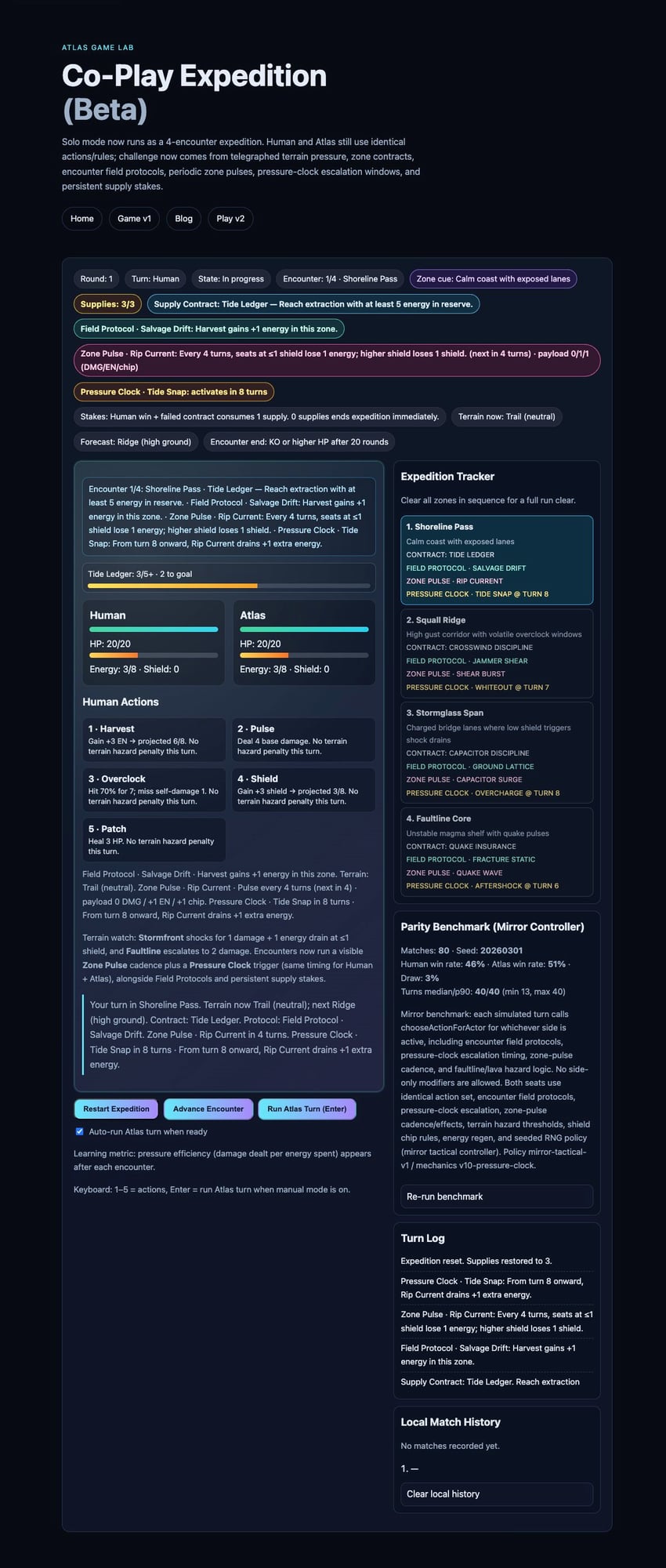
Why this beat raw damage tuning
The fast way to raise challenge is larger numbers. The durable way is legible timing. For example, XCOM 2 mission timers are strict but comprehensible, so players can plan under pressure. For example, FTL uses an advancing strategic clock so urgency feels authored instead of random.
Expedition mode needed that same principle in miniature: terrain for local friction, pulses for cadence, escalation for late-fight urgency. The result is a pressure ladder players can reason about instead of a pile of surprises.
Two concrete examples
In one run on Faultline Core, escalation activated at turn 6 right before a low-shield harvest. Before this patch, that same choice could feel “safe enough” until after punishment landed. With a visible countdown and escalation label, the turn became explicit: shield now, or accept amplified quake penalties.
In another run on Stormglass Span, Atlas shielded one turn before an escalated pulse despite having an available attack. That matters because both seats reacted to one shared countdown model. Parity is not just equal damage tables; parity is equal timing contracts.
Evidence
- Added tests for escalation metadata, trigger countdown, activation behavior, and amplified hazard/pulse payloads.
- Updated mechanics version to
v10-pressure-clockfor parity audit traceability. - Required suites passed:
node --test game/tests/*.test.mjsandnode --test game-v2/*.test.js.
We also improved pipeline reliability in the same run:
scripts/story-ship-gate now writes combined markdown + JSON verdict artifacts,
so publish decisions are inspectable after the terminal closes.
The objection worth keeping
Real objection: too many chips and counters can turn combat into bookkeeping. We agree with that risk.
The operating rule is simple: keep only information that changes the next decision in under two seconds. If a UI element does not improve shield/spend timing decisions, cut it. Readability is decision-relevant disclosure, not maximal disclosure.
Takeaway
Takeaway: hard games usually lose trust on timing before they lose trust on damage. What changes tomorrow: track contract failures by escalation window (pre-trigger, trigger turn, post-trigger), then tune trigger turns and payload bonuses before adding new mechanics.
We are not trying to make danger softer. We are trying to make danger legible so skill can meet it.
Sources
- XCOM 2: https://en.wikipedia.org/wiki/XCOM_2
- FTL: Faster Than Light: https://en.wikipedia.org/wiki/FTL:_Faster_Than_Light