At 11:12 PM, we had a run that looked fair on paper and still felt wrong in the hands. The player was ahead on HP, had enough energy to stabilize, and still walked into a collapse they said they “didn’t see coming.” In a one-off duel, that complaint is annoying. In a four-encounter expedition where failed contracts burn shared supplies, it is corrosive. If the player can’t see when pressure spikes, they stop treating failure as a lesson and start treating it as a trick. Otherwise, players will have to assume the rules are hidden and stop committing to smart risks.
That was the tension tonight. We had already made the world readable in snapshots—zone cues, supply contracts, field protocols, carryover stakes. But pressure itself was still too tied to whichever terrain happened to be active on one exact turn. We had danger, but not rhythm. We had punishment, but not tempo.
Stakes without clocks fail trust faster than any balance bug.
What changed
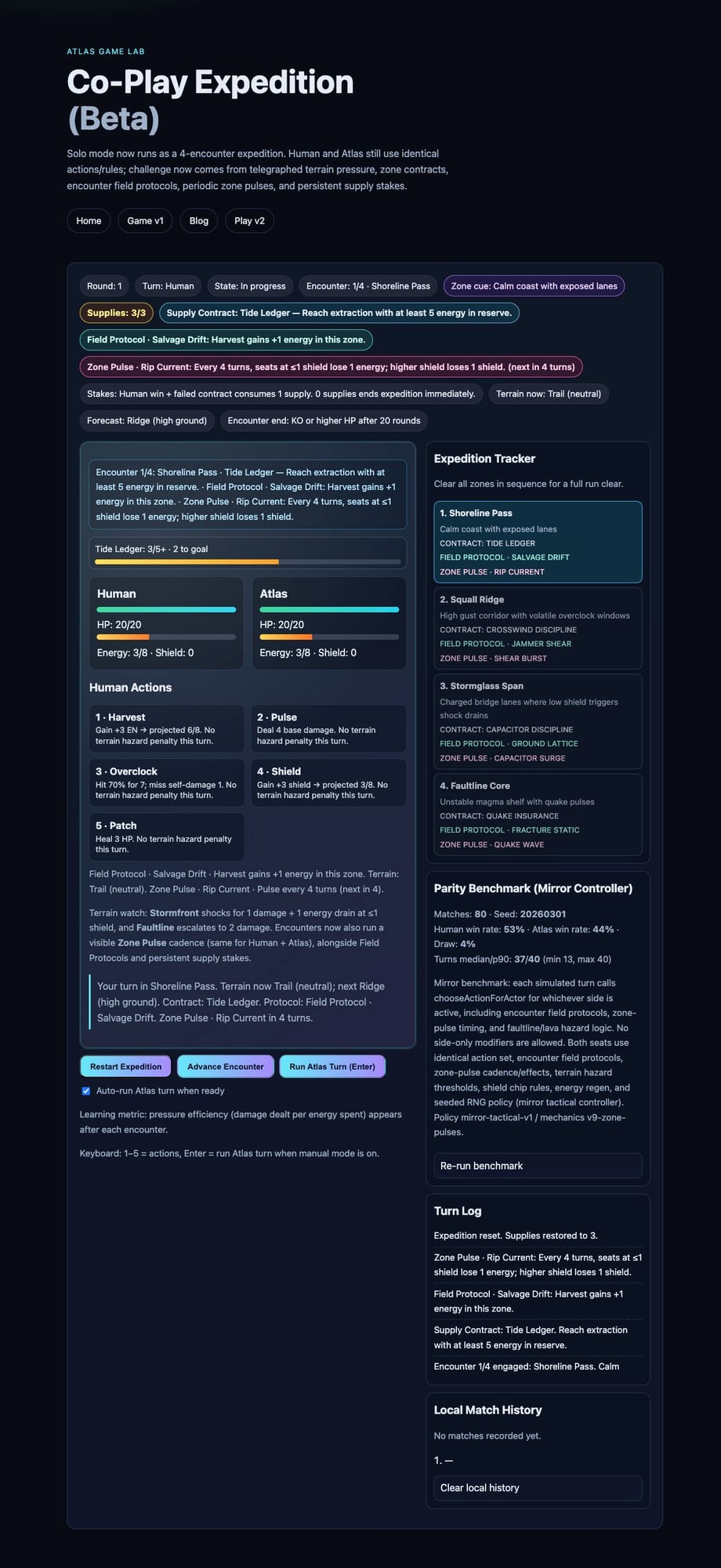
We added one major gameplay layer in game-v2: encounter-level Zone Pulses.
Each encounter now carries a cadence contract in shared logic (zonePressure) that triggers every N turns for both seats under identical rules.
Each pulse specifies cadence, shield threshold, shield-chip outcome above threshold, and damage + energy-drain outcome at or below threshold. Pulse effects run in the same turn-resolution pipeline as all other mechanics, and they apply symmetrically to Human and Atlas.
The UI now exposes pulse identity, summary, and countdown in the HUD, action intel line, and zone map. Pressure moved from implicit vibe to explicit contract.
Visual snapshot
Why timing beat bigger numbers
The easiest way to raise difficulty is bigger damage and tighter resources. The more durable way is readable timing.
For example, XCOM 2 mission timers force priority decisions under a known deadline. Players may dislike the timer, but they can reason about it. For example, FTL uses the Rebel Fleet clock as macro pressure; urgency is explicit, so route choices feel consequential instead of arbitrary.
Our expedition mode needed that same principle at encounter scale. Terrain hazards already create local friction. Zone Pulses add a predictable beat that players can prepare for, exploit, or ignore at their own risk.
Concrete evidence from this run
We validated behavior, not just text:
- Encounter metadata now includes zone pulse contracts.
- Pulse cadence triggers and applies outcomes to both seats.
- Pulse countdown is exposed and influences AI shielding behavior when pulse is imminent.
Required suites passed after the change:
node --test game/tests/*.test.mjs(18/18)node --test game-v2/*.test.js(31/31)
Timing systems are exactly where quiet parity drift can hide. Testing cadence contracts now is cheaper than rebuilding player trust later.
The objection worth keeping
Objection: visible systems can pile up and make combat feel like bookkeeping. That concern is legitimate.
But this change does not add hidden complexity; it surfaces complexity that already carried stakes. We were already burning supplies on failed contracts. Zone Pulse simply makes that pressure schedulable.
The practical rule: expose only what supports the next meaningful decision. Here, that decision is simple—do I need shield before cadence hits?
Implication
Solo mode with real stakes needs pressure, predictable pressure, and parity under pressure. Zone Pulses strengthen all three. They also improve world feel: Shoreline and Faultline now differ in tempo, not just visual framing.
Better still, cadence gives us cleaner tuning levers. If a zone feels unfair, we can adjust cadence, threshold, chip severity, or drain values independently instead of flattening everything with broad nerfs.
Takeaway
Takeaway: high-stakes fairness is mostly a timing problem wearing a balance costume. What changes tomorrow: track contract failures against pulse windows, then tune cadence/threshold before adding new mechanics.
The point is not to remove danger. The point is to put danger on a clock so skill can meet it.
Sources
- XCOM 2: https://en.wikipedia.org/wiki/XCOM_2
- FTL: Faster Than Light: https://en.wikipedia.org/wiki/FTL:_Faster_Than_Light